
Página
Topic 4.7 - Agile glossary
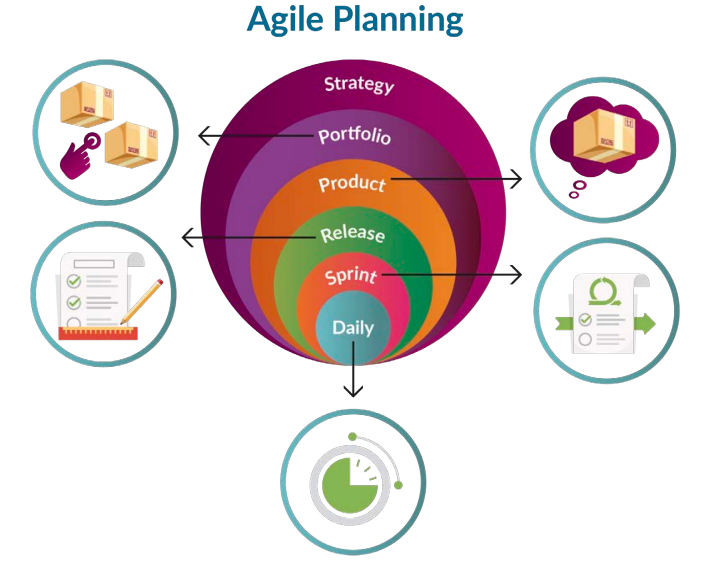
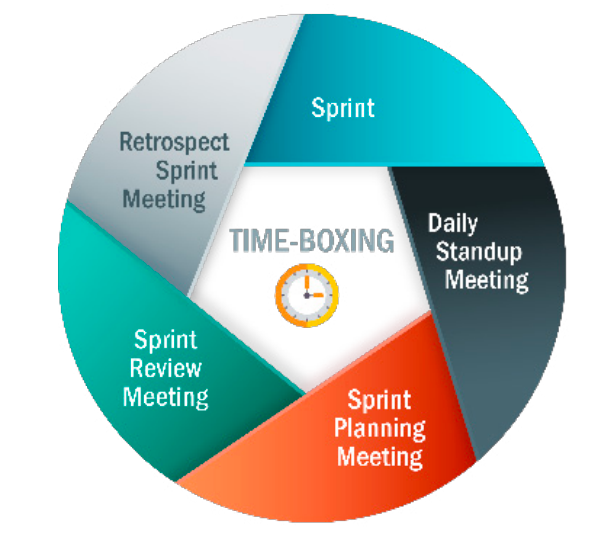
Time-Boxing
All events are blocks of time (maximum time duration), so they all have a maximum duration.
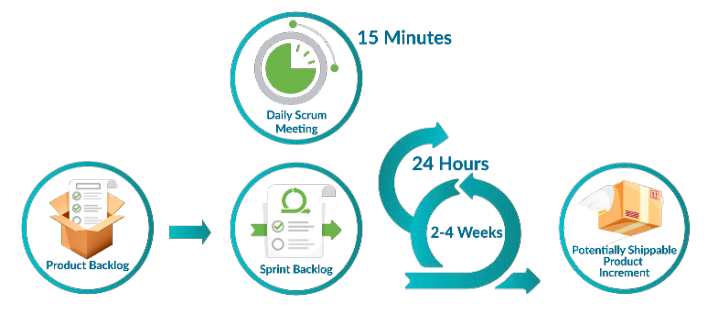
Advantages of Time-Boxing
A timebox is a previously agreed period of time during which a person or a team works steadily towards completion of some goal. Rather than allow work to continue until the goal is reached, and evaluating the time taken, the timebox approach consists of stopping work when the time limit is reached and evaluating what was accomplished.
Benefits:
● Efficient development processes
● Less overhead
● High speed for equipment
● Helps effectively manage project planning and execution
¿Where is Time-Boxing used?
Key Concepts
Epic
An epic is a large user story that cannot be delivered as defined within a single iteration or is large enough that it can be split into smaller user stories.
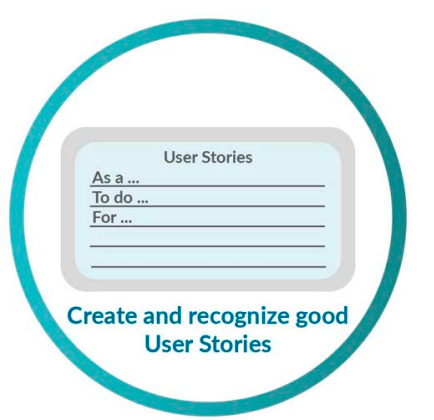
User Stories
In consultation with the customer or Product Owner, the team divides the work to be done into functional increments called ”User Stories".
Each user story is expected to produce, once implemented, a contribution to the value of the product in general, regardless of the order of implementation; The INVEST formula captures these and other assumptions about the nature of users' stories.
Task Board
In its most basic form, a task board can be drawn on a whiteboard or even a section of wall. Using electrical tape or a dry erase pen, the board is divided into three columns labeled “To Do”, “In Progress” and “Done”. Sticky notes or index cards, one for each task the team is working on, are placed in the columns reflecting the current status of the tasks.
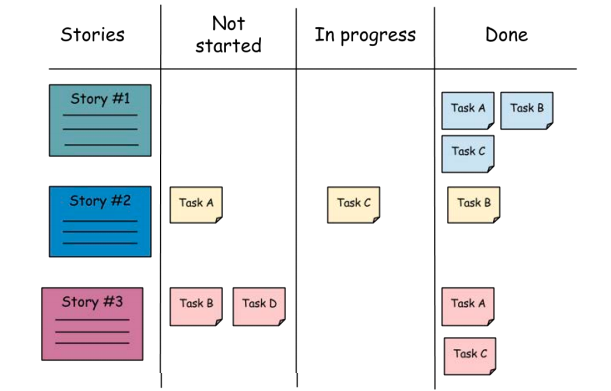
Source: https://www.agilealliance.org/agile101/agile-glossary
INVEST
The acronym INVEST helps to remember a widely accepted set of criteria, or checklist, to assess the quality of a user story. If the story fails to meet one of these criteria, the team may want to reword it, or even consider a rewrite (which often translates into physically tearing up the old story card and writing a new one).
A good user story should be:
● “I” ndependent (of all others)
● “N” egotiable (not a specific contract for features)
● “V” aluable (or vertical)
● “E” stimable (to a good approximation)
● “S” mall (so as to fit within an iteration)
● “T” estable (in principle, even if there isn’t a test for it yet)
Level of Detail

¿How is a User Story formed??
According to Ron Jeffries' formula, a User Story must consist of the 3 C's:
● Card: A physical token (often a Post-It note), which gives tangible and lasting shape to what would otherwise only be an abstraction
● Conversation: That takes place at different times and places during a project between the different people interested by a given feature of a software product: customers, users, developers and evaluators; this conversation is largely verbal but often complemented by documentation
● Confirmation: The objectives around which
Source: https://www.agilealliance.org/glossary/three-cs
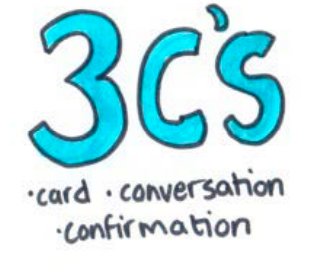
Features: Invest Model


Task
In Scrum it can be defined as the technical work that Developers do to complete a Product Backlog item.
Most tasks are defined as small, which represents no more than a few hours of a day.
¿How is a Task formed?

SMART model features:
S: Specific
M: Measurable
A: Achievable
R: Relevant
T: Timely
Planning Poker Estimate
This is one of the most recognized techniques in Scrum, as it is very simple, fun, and effective, where developers estimate.
It was first defined and named by James Grenning in 2002 and later popularized by Mike Cohn.
A playful approach to estimation, used by many Agile teams.
The team meets in presence of the customer or Product Owner.
Around the table, each team member holds a set of playing cards, bearing numerical values appropriate for points estimation of a user story.
Kanban

The Kanban Method is a means to design, manage, and improve flow systems for knowledge work. The method also allows organizations to start with their existing workflow and drive evolutionary change.
They can do this by visualizing their flow of work, limit work in progress (WIP) and stop starting and start finishing.
The Kanban Method gets its name from the use of kanban – visual signaling mechanisms to control work in progress for intangible work products.
MVP
A minimum viable product (MVP) is a concept from Lean Startup that stresses the impact of learning in new product development.
Eric Ries, defined an MVP as that version of a new product which allows a team to collect the maximum amount of validated learning about customers with the least effort.
This validated learning comes in the form of whether your customers will actually purchase your product.
Velocity
At the end of each iteration, the team adds up effort estimates associated with user stories that were completed during that iteration.
Knowing velocity, the team can compute (or revise) an estimate of how long the project will take to complete, based on the estimates associated with remaining user stories and assuming that velocity over the remaining iterations will remain approximately the same.
This is generally an accurate prediction, even though rarely a precise one.
Scrum of Scrum
A technique to scale Scrum up to large groups (over a dozen people), consisting of dividing the groups into Agile teams of 5-10.
Each daily scrum within a sub-team ends by designating one member as “ambassador” to participate in a daily meeting with ambassadors from other teams, called the Scrum of Scrums.
The Scrum of Scrums proceeds otherwise as a normal daily meeting, with ambassadors reporting completions, next steps and impediments on behalf of the teams they represent.
Resolution of impediments is expected to focus on the challenges of coordination between the teams; solutions may entail agreeing to interfaces between teams, negotiating responsibility boundaries, etc.
The Scrum of Scrum will track these items via a backlog of its own, where each item contributes to improving between-team coordination.
Última modificación: viernes, 20 de agosto de 2021, 08:03